

Grain Storage Silo Manufacturers
Orison Industries is a renowned Grain Storage Silo Manufacturers in India, providing state-of-the-art silos that have proven to be highly efficient in storing grains. These silos are designed for the purpose of preserving grains including wheat, rice, maize, barley, and pulses. It is important to note that grain storage silos play an important role in ensuring that grains that have been harvested are protected from environmental factors such as moisture and pests.
Grain Storage Silo Suppliers in India
As reliable Grain Storage Silo Suppliers in India, we offer custom-designed silos that are needed for diverse storage capacities and industrial purposes. The silos find varied applications in industries dealing with agriculture, grain mills, and grain storage units. The modern designs of silos ensure efficient handling of grains. They help in retaining the quality of grains by offering an environment-controlled storage option.
Key Advantage of Grain Storage Silos Include:
- Safe and hygienic bulk grain storage
- Protection from pests, rodents, and moisture
- Reduced post-harvest losses
- Easy loading and unloading systems
- Long-term storage with minimal maintenance
We concentrate on offering robust and effective silos that are cost-effective and appropriate for varied industrial demands
Applications Include:
- Agricultural grain storage facilities
- Flour mills and rice mills
- Food processing industries
- Government storage warehouses
- Export and import grain storage units
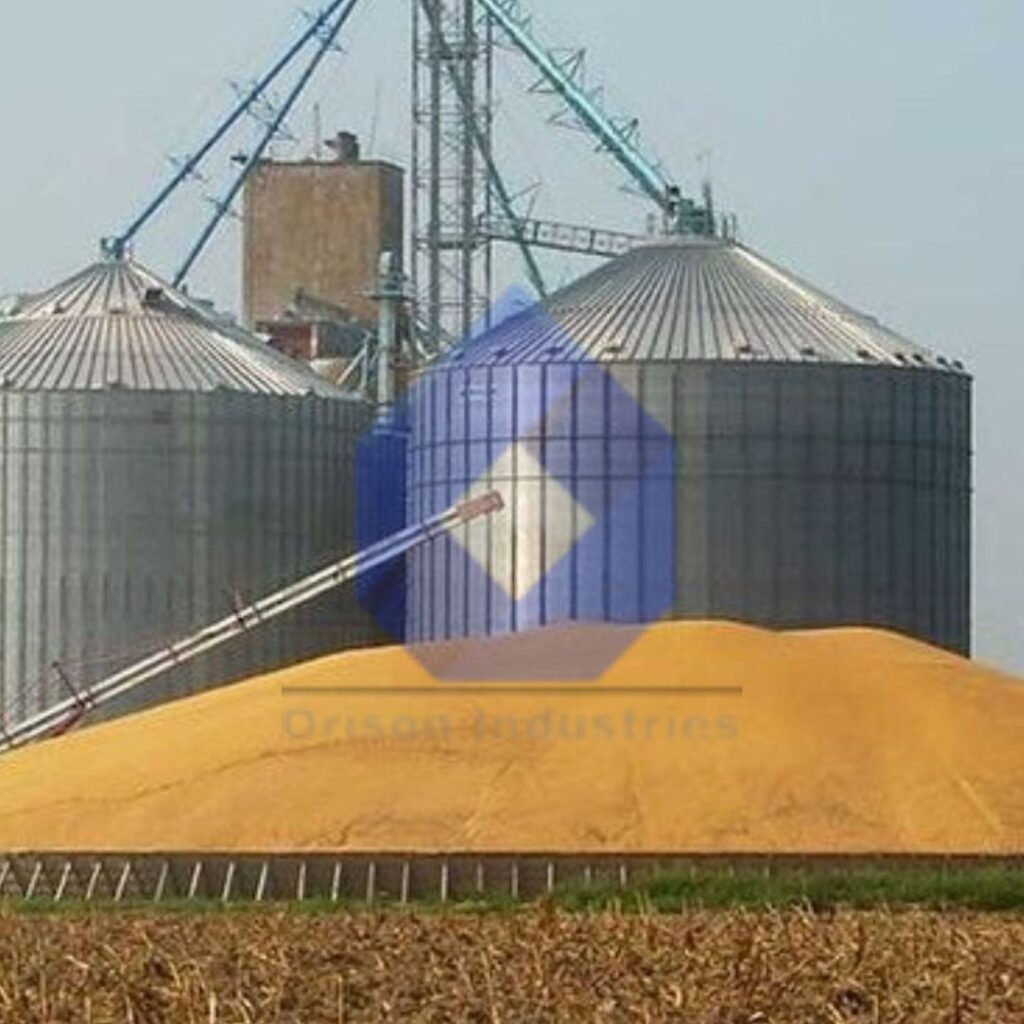
Grain silos are vital structures in today’s agricultural and food production industries. Silos offer a well-controlled environment that aids in maintaining the integrity of grains during long durations. Orison Industries provides designs of silos that will offer maximum security and efficiency. The silos are made from high-quality material capable of withstanding difficult climatic conditions and regular use.
Benefits include:
- Maintains grain freshness and nutritional value
- Prevents fungal and bacterial growth
- Ensures better inventory management
- Reduces manual handling and labor costs
- Improves storage safety and efficiency
Every silo manufactured by Orison Industries is built to comply with recognized standards such as IS 5503, ANSI, ASAE, and DIN, depending on the client’s location and application requirements. Our manufacturing process begins with selecting galvanized steel with zinc coatings ranging from 275 GSM to 450 GSM, ensuring long-term resistance to corrosion and weather damage — even in humid or coastal regions of India.
Beyond material quality, we focus on structural engineering that accounts for grain pressure, wind load, and seismic considerations at the installation site. Each silo is designed with a reinforced concrete foundation, safety-caged ladders, and optional aeration and temperature-monitoring systems, giving our clients — from individual farmers to government storage warehouses — a solution built for a 25+ year service life with proper maintenance.
Grain Storage Silo Price in India
Grain Storage Silo Price in India varies based on certain elements like storage capacity, design of silo, quality of materials, aeration facilities, automation, and installation needs. Silos having small storage capacities are cheaper whereas the industrial silos used for storing bulk grains are relatively costly to install. There are other factors too which affect the final price of the silo. The use of a good quality grain storage silo is beneficial to farmers as it reduces losses after harvest and ensures efficient grain storage.
Technical Specification
| Parameter | Specification |
|---|---|
| Silo Type | Flat Bottom Silo / Hopper Bottom Silo |
| Storage Capacity | 10 MT to 10,000 MT (customizable) |
| Material of Construction | High-quality galvanized steel (Zinc coating 275 GSM to 450 GSM) |
| Silo Diameter | 2.75 meters to 30 meters |
| Silo Height | Varies as per capacity (up to 30 meters) |
| Roof Type | Conical roof with manhole and ventilation |
| Roof Angle | 25° to 30° (standard) |
| Hopper Slope (for hopper silos) | 45° to 60° |
| Sidewall Sheets | Corrugated galvanized steel, 1 mm to 4 mm thick |
| Foundation | Reinforced concrete base with anchor bolts |
| Ladders & Platforms | Galvanized steel ladder with safety cage and rest platforms |
| Aeration System | Included – Aeration fan, perforated floor/plenum |
| Temperature Monitoring System | Optional multi-point digital temperature sensors |
| Grain Discharge | Manual/automatic discharge gates with conveyor system |
| Fumigation System | Optional gas-tight sealing for pest control |
| Moisture Control | Optional integration with dehumidifier or dryer system |
| Dust Collection | Provided through roof vents or filters |
| Design Life | 25+ years with proper maintenance |
| Compliance Standards | IS 5503 / ANSI / ASAE / DIN (as per client location) |
Frequently Asked Questions
A grain storage silo is a specially designed structure used to store wheat, rice, maize, barley, pulses, and other grains in bulk while helping protect them from moisture, pests, and contamination.
Grain storage silos help reduce post-harvest losses, improve bulk storage management, protect grain quality, optimize storage space, and simplify loading and unloading operations.
Common types include flat bottom silos and hopper bottom silos. The right option depends on storage capacity, grain characteristics, discharge requirements, and available space.
Grain storage silos are available in different capacities depending on the application. Orison Industries lists customizable capacities from 10 MT to 10,000 MT on its product page.
Grain storage silos are commonly manufactured using galvanized steel, zinc-aluminium-coated steel, or concrete, depending on the design and storage requirements.
The price depends on storage capacity, construction material, silo design, aeration systems, temperature monitoring, automation, transportation, and installation requirements.
Properly designed silos use suitable sealing, ventilation, aeration, and pest-management measures to help control storage conditions and reduce the risk of grain deterioration.
A flat bottom silo has a flat base and is commonly used for large-volume storage. A hopper bottom silo has a sloped bottom that helps grains flow toward the discharge outlet, making unloading easier.