
Industrial facilities, commercial buildings, agricultural businesses, and water treatment plants often require reliable storage systems to manage large volumes of water and other compatible liquids. A bolted steel tank is a practical solution for these requirements because it offers a modular design, convenient transportation, and flexible installation options. Unlike conventional welded tanks, these tanks are assembled by joining prefabricated steel panels with bolts and suitable sealing materials.
At Orison Industries, selecting the right storage solution starts with understanding the application, storage capacity, site conditions, and long-term operational requirements. Whether a project requires an industrial water storage system, a fire protection reserve, or bulk liquid storage, understanding the design and benefits of bolted steel tanks can help buyers make informed decisions.
In this guide, we will explore what a bolted steel tank is, how it is designed, its major benefits, and where it is commonly used.
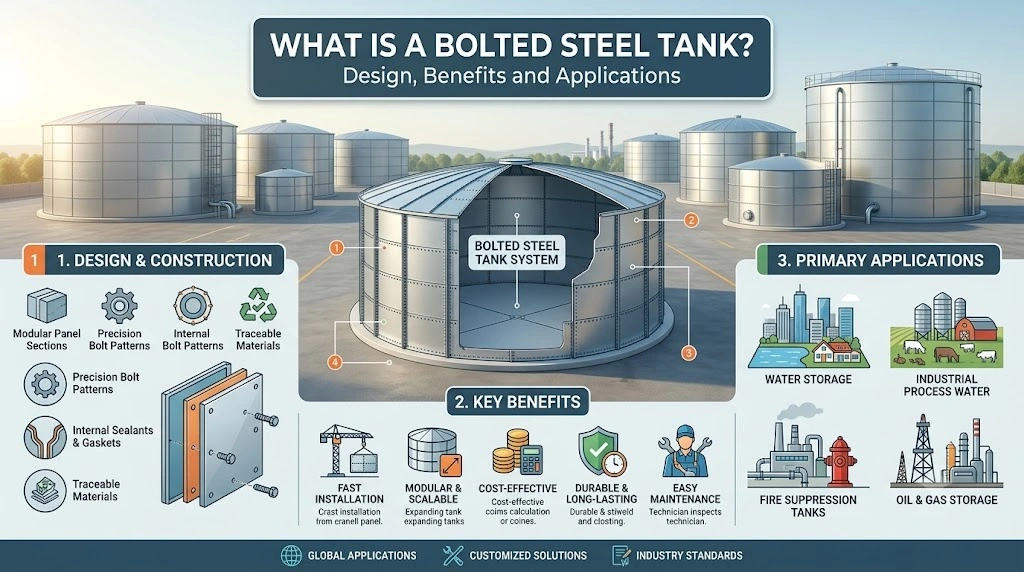
What Is a Bolted Steel Tank?
A bolted steel tank is a storage structure manufactured from prefabricated steel panels that are connected using high-strength bolts, gaskets, and other suitable sealing components. These panels are assembled at the installation site to create a tank of the required dimensions and capacity.
The modular construction makes bolted tanks suitable for projects where transporting a fully fabricated tank would be difficult or expensive. Individual panels can be transported separately and assembled at the destination, depending on the tank design and project requirements.
These tanks are available in different configurations, coatings, and capacities. Their suitability depends on the stored liquid, environmental conditions, structural requirements, and applicable industry standards.
Bolted steel tanks are widely considered for industrial water storage, firefighting systems, wastewater treatment facilities, agricultural operations, and commercial infrastructure.
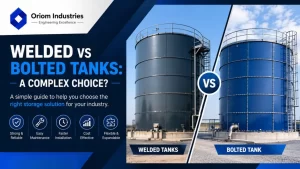
Also Read: Welded vs Bolted Tanks: Which Storage Solution is Right for Your Industry?
How Is a Bolted Steel Tank Designed?
The design of a bolted steel tank involves more than connecting steel panels. Each component must work together to provide structural stability, effective sealing, and safe storage under the expected operating conditions.
1. Prefabricated Steel Panels
The tank body consists of steel panels manufactured to specified dimensions. Depending on the design, the panels may feature protective coatings to improve corrosion resistance and service life.
A panel tank can be configured according to the available site area and required storage volume.
2. Bolted Connections
The individual panels are connected using bolts, nuts, and other specified fastening components. Correct bolt selection, tightening procedures, and joint detailing are essential for maintaining structural integrity.
3. Sealing System
Gaskets or approved sealants are fitted between panel joints to prevent leakage. The sealing material must be compatible with the stored liquid and the operating temperature.
4. Protective Coating
Depending on the application, steel panels may use galvanized, zinc-aluminium, epoxy, or other suitable protective coatings. The choice depends on corrosion exposure, water quality requirements, and maintenance expectations.
5. Foundation and Structural Support
A properly designed foundation distributes the tank load and supports stable operation. Foundation requirements depend on tank dimensions, filled weight, soil conditions, seismic considerations, and local design requirements.
6. Roof, Inlet and Outlet Arrangements
Depending on the application, the tank may include a roof, access openings, ventilation, overflow connections, drainage, and inlet and outlet nozzles. These components are selected according to the intended use and operating requirements.
A professionally engineered design helps ensure that the tank meets the project’s storage, structural, and safety needs.
Key Benefits of Bolted Steel Tanks
Bolted steel tanks offer several advantages for industrial and commercial storage projects.
1. Modular Construction
One of the main advantages of bolted steel tanks is their modular design. Individual panels can be transported and assembled at the installation location. This is particularly useful for remote industrial facilities, agricultural sites, and locations with restricted transportation access.
2. Flexible Storage Capacity
Bolted tanks can be designed in different dimensions and capacities. This flexibility helps businesses select a storage solution that matches their current requirements and available space.
For projects that may expand in the future, the feasibility of adding capacity should be discussed during the initial design stage.
3. Easier Transportation
Transporting a large, fully fabricated tank can involve logistical challenges. Bolt-together water storage tanks are delivered as separate components, which can simplify transportation and handling in many situations.
This feature makes them suitable for projects where access roads, lifting arrangements, or delivery routes limit the movement of large structures.
4. Faster Site Assembly
Since the tank panels are prefabricated, installation mainly involves preparing the foundation, positioning the panels, completing the bolted connections, and installing the required accessories.
The actual installation time depends on tank size, site readiness, weather, access, and workforce experience.
5. Corrosion Protection Options
Protective coatings help reduce corrosion and support long-term performance. The correct coating system is especially important when tanks are exposed to moisture, industrial environments, or aggressive water conditions.
Regular inspection and appropriate maintenance remain necessary to preserve the coating and tank structure.
6. Convenient Inspection and Maintenance
Individual joints, fasteners, coatings, and accessories can be inspected as part of a planned maintenance programme. Depending on the design, certain components may be repairable or replaceable without replacing the entire tank.
Any maintenance or repair work must follow the manufacturer’s instructions and appropriate safety procedures.
7. Versatile Applications
Bolted steel tanks can be configured for various storage purposes, including potable water, firewater, industrial process water, and wastewater applications. However, the tank lining, coating, sealing system, and construction materials must be suitable for the specific liquid.
Common Applications of Bolted Water Storage Tanks
Bolted water storage tanks are used in many industries because they can accommodate different capacities and installation conditions.
1. Industrial Water Storage
Manufacturing plants require water for production processes, equipment cleaning, cooling, and general utility operations. Bolted water storage tanks can provide a dedicated storage reserve to support these activities.
The required tank capacity depends on daily consumption, supply reliability, process demand, and emergency requirements.
2. Fire Protection Systems
Firewater storage tanks supply water to firefighting systems such as hydrants and sprinklers. Their design must meet the applicable fire protection requirements, including the required storage volume, duration, water demand, and replenishment arrangements.
For these projects, buyers should ensure that the tank and its accessories comply with the relevant standards and approvals.
3. Water and Wastewater Treatment Plants
Treatment facilities need storage for raw water, treated water, and certain compatible process liquids. Bolted steel tanks can be considered for these applications when the selected materials and protective systems are compatible with the stored liquid.
Wastewater composition should be assessed before choosing the tank coating and sealing materials.
4. Agriculture and Irrigation
Agricultural operations use storage tanks to maintain water supplies for irrigation, livestock facilities, and other farm activities. A suitable tank can help manage seasonal demand and provide a reserve during supply interruptions.
5. Commercial and Institutional Buildings
Hotels, hospitals, residential developments, educational institutions, and commercial complexes may require substantial water storage capacity. A panel tank can provide a modular option for projects with specific space and installation requirements.
6. Infrastructure and Remote Projects
Construction sites, industrial developments, and remote facilities may require dependable water storage where transportation and installation conditions are challenging. The modular construction of bolted tanks can help address some of these logistical requirements.
Bolted Steel Tanks vs Welded Steel Tanks
Both bolted and welded steel tanks are used for industrial storage, but their construction methods differ.
| Feature | Bolted Steel Tanks | Welded Steel Tanks |
|---|---|---|
| Construction | Prefabricated panels joined with bolts | Steel components joined by welding |
| Transportation | Panels can be transported separately | Large fabricated sections may require specialized transport |
| Site installation | Assembled using bolted connections | Often requires site or workshop welding |
| Site requirements | Requires correct alignment, fastening and sealing | Requires suitable welding equipment, skills and inspection |
| Maintenance | Joints, bolts and coatings require inspection | Welds, coatings and structural areas require inspection |
| Suitability | Depends on design, capacity and application | Depends on design, capacity and application |
Neither construction method is universally better. The appropriate option depends on project specifications, site access, storage requirements, applicable standards, installation conditions, and total lifecycle cost.
How to Choose the Right Bolted Steel Tank
Before purchasing a bolted steel tank, consider the following factors:
- Storage capacity: Calculate the required working volume based on consumption, supply patterns, and reserve requirements.
- Stored liquid: Confirm compatibility between the liquid and the steel, coating, gasket, and sealant materials.
- Tank dimensions: Check the available installation area, height restrictions, access, and maintenance clearance.
- Corrosion protection: Select a coating suitable for the environment and expected operating conditions.
- Structural design: Consider wind loads, seismic conditions, liquid pressure, foundation requirements, and applicable engineering standards.
- Accessories: Identify the need for ladders, platforms, manholes, vents, level indicators, overflow pipes, and other connections.
- Installation support: Confirm assembly requirements, inspection procedures, and commissioning arrangements.
- Lifecycle cost: Evaluate transportation, foundation work, installation, maintenance, and expected service requirements rather than considering the initial purchase price alone.
Discussing these factors with an experienced storage tank supplier can help reduce design mismatches and avoid unnecessary project costs.
Why Choose Orison Industries for Storage Tank Solutions?
Choosing a storage tank supplier requires careful consideration of product suitability, engineering requirements, installation conditions, and long-term maintenance.
Orison Industries provides storage tank solutions for industrial and infrastructure requirements. When evaluating a bolted steel tank for your project, it is important to communicate the intended application, required capacity, site conditions, and any relevant water quality or compliance requirements.
A suitable solution should account for the tank structure, protective coating, joint sealing system, accessories, and foundation requirements. Buyers should confirm the available tank configurations, technical specifications, installation support, and warranty terms directly with the company.
The goal is to select a storage system that meets the project’s operational needs while supporting safe, dependable, and efficient long-term use.
Conclusion
A bolted steel tank is a practical storage option for projects that require modular construction, convenient transportation, and flexible capacity options. Its prefabricated panels, bolted connections, and application-specific coating systems make it suitable for a range of industrial, agricultural, commercial, and infrastructure uses.
However, successful performance depends on proper engineering, compatible sealing materials, a suitable foundation, correct assembly, and regular maintenance. Before selecting bolted water storage tanks, buyers should carefully assess the intended liquid, storage volume, site conditions, and applicable design standards.
Orison Industries can be contacted to discuss your storage requirements and identify the specifications that should be considered when planning a suitable tank solution.
Frequently Asked Questions (FAQs)
1. What is a bolted steel tank used for?
A bolted steel tank is used to store water and other compatible liquids in industrial, agricultural, commercial, and infrastructure applications. Common uses include firewater storage, process water storage, and water treatment facilities.
2. What are bolt-together water storage tanks?
Bolt-together water storage tanks are modular tanks made from prefabricated panels connected with bolts and suitable sealing materials. They are assembled at the installation site according to the specified design.
3. What is a panel tank?
A panel tank is a storage tank assembled from individual prefabricated panels. Depending on the design and materials, panel tanks can be used for commercial, industrial, and institutional water storage.
4. Are bolted steel tanks suitable for drinking water?
Yes, provided the tank materials, protective coating, gaskets, and other wetted components are approved or certified for potable water use under the applicable requirements.
5. What affects the cost of a bolted steel tank?
The cost depends on storage capacity, steel grade, coating system, tank dimensions, accessories, foundation requirements, transportation, installation, and applicable compliance requirements.
6. How long does a bolted steel tank last?
The service life depends on the steel and coating system, environmental exposure, stored liquid, installation quality, and maintenance practices. Regular inspection helps identify issues before they affect tank performance.
7. How do I choose the right bolted water storage tank?
Consider the required capacity, liquid type, site dimensions, corrosion protection, structural requirements, accessories, installation conditions, and long-term operating costs before making a selection.